|
| A Trip to the Holy Land. |
The ground hallowed by the footprints of our divine Lord and Saviour, the scene of His miracles and His passion, the land endeared to us by the presence of His immaculate Mother and her chaste spouse, St. Joseph, has for the Christian more tender memories, perhaps, than any spot on earth.
As a fitting close to our book, come then with me, dear reader, and take the slight glimpse which our space permits at this cradle of Christianity.
Jaffa.
Taking a steamer at Alexandria, the once magnificent city of Egypt, a sail of two days brings us to Jaffa, the usual starting-point for the pilgrim to the Holy Land. Here we find shelter and refreshment at the monastery and hospice of the Franciscan Fathers, whose open doors give welcome to the stranger, no matter what his country or his creed.
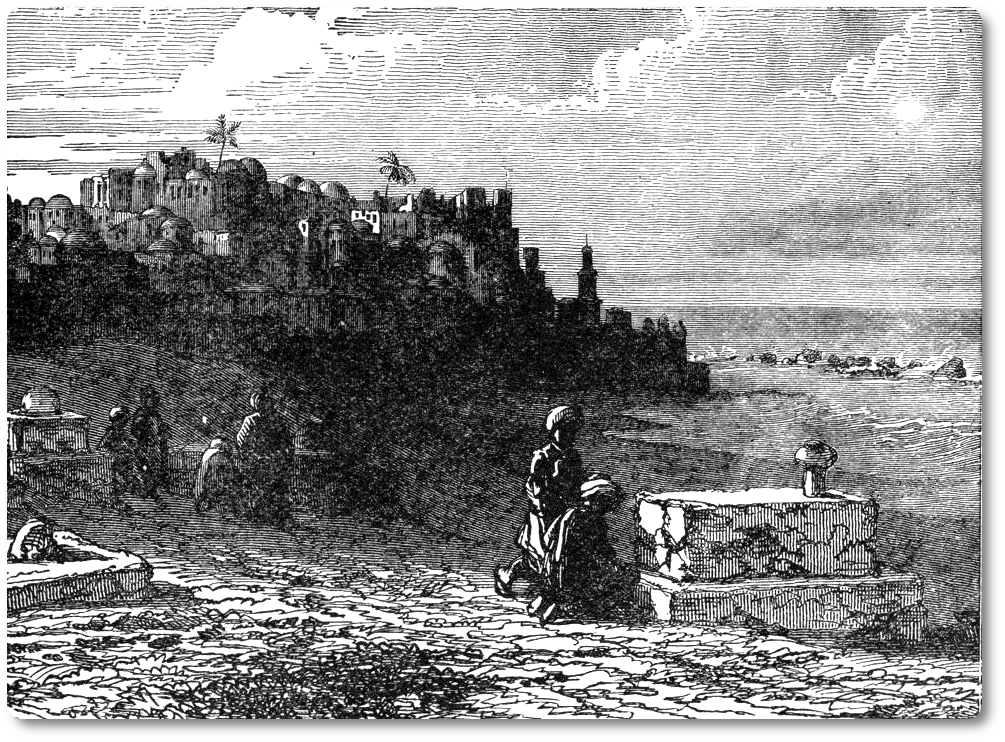
Jaffa, or Joppe, as it was formerly called, is probably the oldest port, and is on the site of one of the oldest cities in the world. Here Noe is supposed to have entered the Ark, and here he is said to have been buried. It is situated on a tongue of land projecting into the Mediterranean, thirty-one miles northwest of Jerusalem. It was once the port of Jerusalem, and the landing-place of the cedars with which the temple was built. Here the prophet Jonas took ship to flee from the face of the Lord, and here, in the house of Simon the tanner, St. Peter raised Tabitha to life.
We read in the First Book of Machabees that Jonathan Machabeus and his brother Simon attacked and captured the city. It was there that Jonathan met Ptolemee, the king of Egypt. It is uncertain when Jaffa first became the seat of a Christian bishop. In more modern times it was taken by Godfrey de Bouillon, but its fortifications were destroyed in 1188 by Saladin. They were rebuilt, however, by Richard of England. Later on, in 1253, it was occupied by St. Louis of France. Finally, it fell into the hands of the Turks, who still have possession of it. The town at present has about 10,000 inhabitants of whom probably 1200 are Catholics. Its trade is in cotton, corn, fruits, and corals; its oranges are the finest in all Palestine and Syria, and its gardens and orange and citron groves are deliciously fragrant and fertile.
Jerusalem.
The journey from Jaffa to Jerusalem was formerly made in carts, but in 1890 a railway, which connects the two places, was opened. On the way we pass the ancient town of Ramleh, and a few miles further on Lydda. It was in the latter town that St. Peter cured the man Eneas who was "ill of the palsy," and had kept his bed for eight years, and from there he went to Jaffa to raise Tabitha to life. Lydda is nine miles from Jaffa, and, considering all circumstances, is busy and prosperous. It was an Episcopal see as far back as the year 404. St. George, the patron saint of England, was a native of Lydda, and was buried there. A church was built over his remains, and named in his honor, but it was destroyed in the early part of the eighth century, when the country was taken possession of by the Saracens. It was afterwards rebuilt, but again destroyed, to be rebuilt by Richard Coeur de Lion.
Mount Olivet.
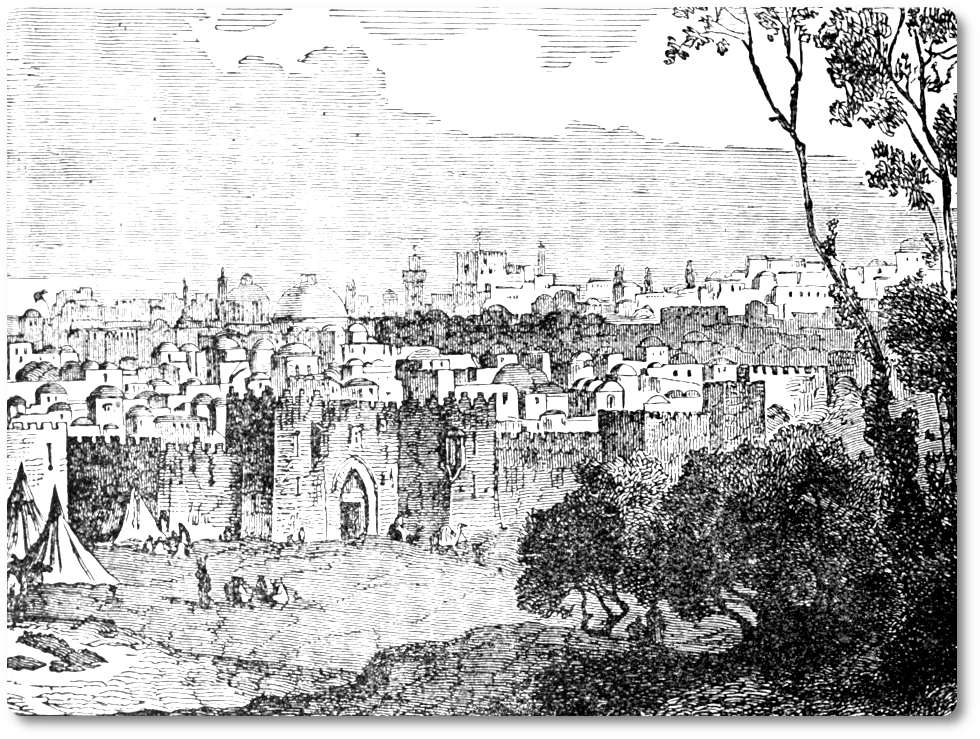
We now reach Jerusalem. The Holy City lies near the summit of a broad mountain-ridge. This mountainous tract everywhere forms the precipitous western wall of the great valley of the Jordan and the Dead Sea. All around are higher hills: on the east, the Mount of Olives; on the south, the Hill of Evil Counsel, rising directly from the valley of Ennom or Hinnom, as it is now called; on the west, the ground rises gently to the borders of the great Wady ; while on the north a bend of the ridge connected with the Mount of Olives bounds the prospect at the distance of more than a mile. Towards the southwest the view is somewhat more open ; for here lies the plain of Raphaim, beginning just at the southern brink of the Valley of Hinnom, and stretching off southwest where it is drained to the western plain. In the northwest, too, the eye reaches along the upper part of the Valley of Josaphat; and from many points can discern the Mosque of Neby Samwil, situated on a lofty ridge beyond the great Wady.
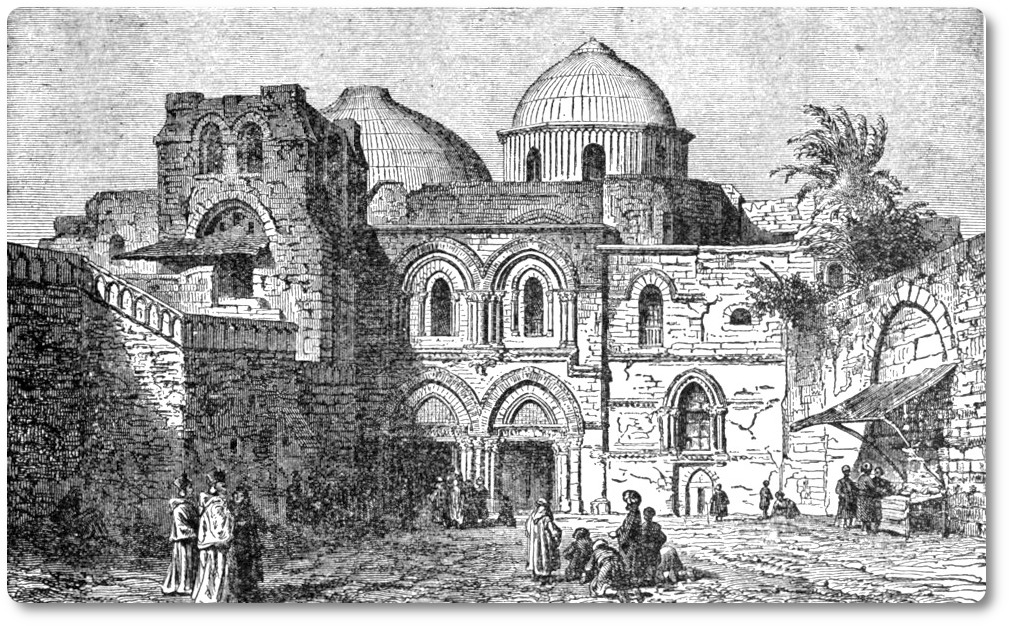
Naturally, the great point of interest for the Christian in Jerusalem is the CHURCH OF THE HOLY Sepulchre. This is built so as to cover every part of Calvary sanctified by the presence of Our Lord during His passion.
The name Calvary, called Golgotha in Hebrew, means skull. An ancient tradition has it that the skull of Adam was buried there, that it had been preserved and taken into the Ark by Noe, whose son Sem afterward buried it in this mountain. Another tradition relates that it was at this place that Abraham prepared to sacrifice Isaac, and some Greek monks have a con vent and chapel there built to commemorate that event. This hill of Calvary is situated in the western part of Jerusalem, and beyond it was a garden, and probably a villa, belonging to Joseph of Arimathea. Between this garden and Calvary there must have been a narrow valley , and here Joseph had a sepulchre hewn out of the rock, which was in the eastern part of the garden, facing Calvary. This sepulchre consisted of two rooms ; in the inner one was the grave proper, also hewn out of the rock ; the entrance from the outer apartment was very low and was closed by rolling a large stone against it.
The church, which runs east and west, was built chiefly with reference to the holy sepulchre and to the place where the cross was planted. The sepulchre is right under the cupola of the basilica. A great part of the rock of Calvary has been left untouched, though the upper surface has undoubtedly been smoothed ; this part, called the Chapel of Calvary, is reached by ascending eighteen steps. The distance from the place where the cross stood to the sepulchre is ninety feet. As we enter the church from the south directly before us is the Stone of Unction, where Our Lord's body was placed when it was anointed by Joseph of Arimathea and Nicodemus. It is the custom among Catholics to kneel and kiss the stone as they enter. The holy sepulchre, as we have said, is in the centre of a rotunda. The chapel which encloses it is about twenty-six feet long by eighteen broad, and contains two small chambers, to which the only approach is by a door on the east side. The outer chamber is called the Chapel of the Angel, the inner one is the sepul- chre. The Chapel of the Angel is regarded as the place where the angel appeared to the women who were coming to the sepulchre on Easter morning. All that it contains is a portion of a marble slab, said to be the very stone which closed the sepulchre, and on which, after he rolled it away, the angel sat. A narrow, low door leads out of the chapel into a sort of grotto, only seven feet by six, and eight or nine feet high. More than half of this space is occupied by a kind of altar or pedestal, not quite three feet high, which covers and protects the real sepulchral couch where the body of Our Lord was laid.
Church of the Holy Sepulchre.
Without doubting that the Church of the Holy Sepulchre corresponds with the true sites of the passion and resurrection of Our Saviour, it may interest our readers if we trace its his- tory so as to ascertain the degree of firmness with which one may hold the belief that it is the true site. That from the very first the places where Our Lord was crucified and rose again were visited and reverenced by many of the Christians of Jerusalem it is impossible to doubt. The tomb, the pillar, the inscription, the fixed feast, the annual rite were powerful helps to that devotion which aimed at bringing the facts of the passion and the lives of the martyrs more vividly before the mind, and arousing for these last an imitative enthusiasm. "His sepulchre is with us to this present day " (Acts ii. 29). This meant much to the Jews whom St. Peter reminded of it, and considera tions of the like order mean much to us to-day. Some forty years after the crucifixion occurred the siege and destruction of Jerusalem. During the siege the Christians in the city withdrew to Pella, on the other side of the Jordan ; but the time was not long enough to cause a break in their recollections. Besides, in spite of the devastation and destruction which followed the collapse of the Jewish resistance, no violence could injure the rock of Calvary or the tombs in the neighboring garden. The Jewish revolt during the reign of the Emperor Hadrian was the occasion, when suppressed, of an order prohibiting all Jews from entering the city ; but this did not extend to the Christians. Hadrian was determined to make Jerusalem a completely Roman city under pain of death ; he renamed it, and profaned both the site of the temple and the places made sacred by Our Saviour's passion by pagan statues. When Constantine resolved to build a church at Jerusalem on or near the site of the passion, that site was found to be covered over by a huge mound of earth, surmounted by a statue of Venus, which godless men had heaped there in order to efface all that was most precious to Christians. Constantine had the earth re moved, the rock tomb from which Our Saviour had risen was found uninjured beneath it, architects were set to work, and by the year A.D. 335 the entire site — including the place where St. Helena found the cross, the Golgotha, and the cave of the sepulchre, with the intervening ground — was occupied by a symmetrical mass of buildings. But the place of the resurrection, surrounded on three sides by porticoes, and having the Basilica of the Saviour on the east side, was left open to the air. In 614 Jerusalem fell into the hands of the Persians, who set the basilica on fire. When they had retired, Bishop Modestus undertook the task of rebuilding it, but instead of the vast pile of Constantine three edifices arose. Thus they remained till the time of the crusades. After Jerusalem was taken by Godfrey de Bouillon great building works were undertaken, and the result, speaking generally, is the Church of the Holy Sepulchre as it is now.
"Within the Church of the Holy Sepulchre many other places claim our attention. Crossing the rotunda, we come to the Chapel of St. Mary Magdalen, built on the spot where Our Lord appeared to that penitent. About sixty feet further on is the Prison of Christ. According to a pious legend, when Our Lord arrived at Calvary, as everything was not in readiness for the crucifixion, He and the two thieves were placed in a dry cistern or grotto, which has since borne the above name. Another altar close by marks the place where the soldiers divided Our Lord's garments among them. Before ascending to the chapel on Calvary there is the column of Improperia, or the stone on which Our Lord sat when He was crowned with thorns and mocked in the pretorium. Tradition tells us that after His resurrection Our Lord appeared to His blessed Mother, who had remained in the vicinity of His sepulchre during the three days His body was entombed. The scene of this event is marked by the Chapel of the Apparition. This chapel has three altars. On the high altar in the centre the Blessed Sacrament is kept. The one to the right is called the altar of relics, because a piece of the true cross was venerated there till the year 1557, when this precious relic was removed to Armenia. The altar to the left contains a small portion of the pillar at which our blessed Lord was scourged. Once a year, on the Wednesday in Holy Week, the faithful are allowed to see and venerate this relic.
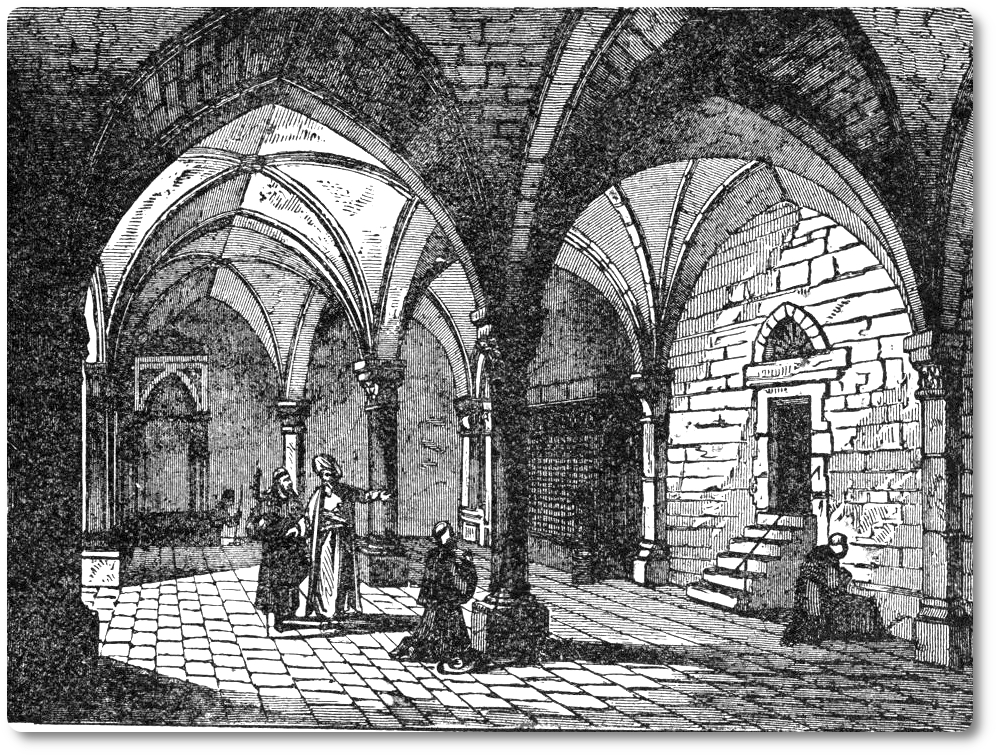
The Hall of the Last Supper in Its Present State.
Descending a stairway, we find ourselves in the Chapel of the True Cross. Here there are two altars, one dedicated to St. Helena, the mother of the Emperor Constantine, the other to Dismos, the penitent thief. A further flight of stairs brings us to the actual spot where the cross was found. It will be remembered that St. Helena was divinely directed to this spot to find the true cross, which had been lost for years. She had the pagan temple pulled down, the accumulated rubbish removed, and excavations made, until at last her search was rewarded by the discovery of the three crosses. But, as the inscriptions were detached, how to determine which of the three was the cross of Christ? In this dilemma Macarius, the holy Bishop of Jeru salem, conceived the idea of carrying the three crosses to a well-known pious lady of the city who was lying dangerously ill. In presence of the empress and her attendants two crosses were applied to the sick woman without avail, but no sooner was she touched with the third cross than she felt new life coursing through her hitherto withered and paralyzed limbs, and she immediately arose from her bed in the full enjoyment of health and strength. Later on a dead man who was touched by the cross was restored to life, thus establishing without doubt its authenticity. In another part of the basilica is the Chapel of the Crucifixion. At the eastern end of this chapel are two altars. Beneath the one on the left is a marble slab with a round hole in the centre, through which the visitor may reach to the hole in the solid rock in which the cross of Our Saviour was planted. A little to the right, near the other altar, is the rent in the rock made at the death of Our Lord, as recorded in the Scripture : "The earth quaked and the rocks were rent" (Matt, xxvii. 52).
Passing out from the Church of the Holy Sepulchre, let us visit the Coenaculum or Chamber of the Last Supper. Here it was that our blessed Lord instituted the Sacrament of the Blessed Eucharist, and in an upper room of this same house the Holy Ghost descended on the apostles at Pentecost. The supper-room is about fifty feet long by thirty wide ; the building is remarkable as being one of the few which escaped destruction when the city was taken by Titus.
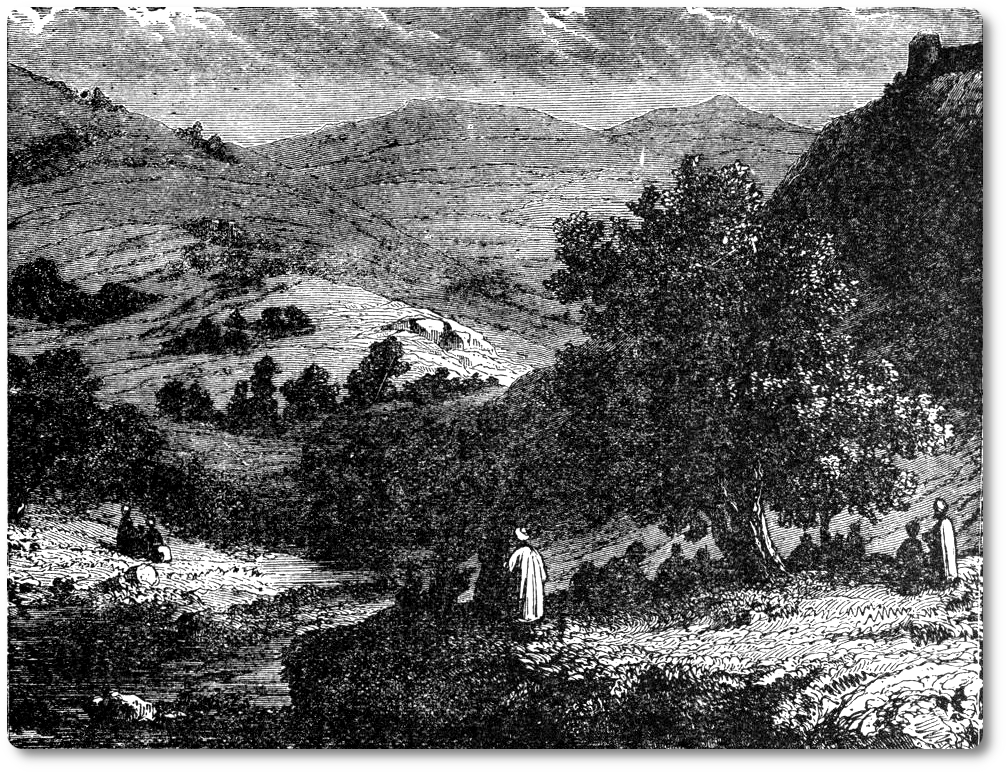
The Valley of Josaphat.
Let us now visit the site of the temple on Mount Moria, now occupied by the Mosque of Omer. The original temple was destroyed by the Babylonians, but was afterwards rebuilt on a scale of even greater grandeur than at first. During the siege of Titus the building was again destroyed, and although later on Julian the apostate attempted to rebuild it, flames of fire issued from the earth, killing the workmen, and the work was abandoned. In the year 636 a mosque was erected on the site ; this passed from the possession of the Saracens to that of the Christians, and back again to the Turks, more than once, finally to become a mosque, which it is at the present day.
On the eastern side of Mount Moria is a wall the lower part of which is believed by some to be a portion of the ancient temple of Jerusalem. It is fifty-two yards long and fifty-six feet high and is known as the Wailing Place. Here on Friday evening the Jews of the city assemble, and, standing with their faces to the wall, they pray with great earnestness, rocking their bodies to and fro, lamenting the misfortunes of their people.
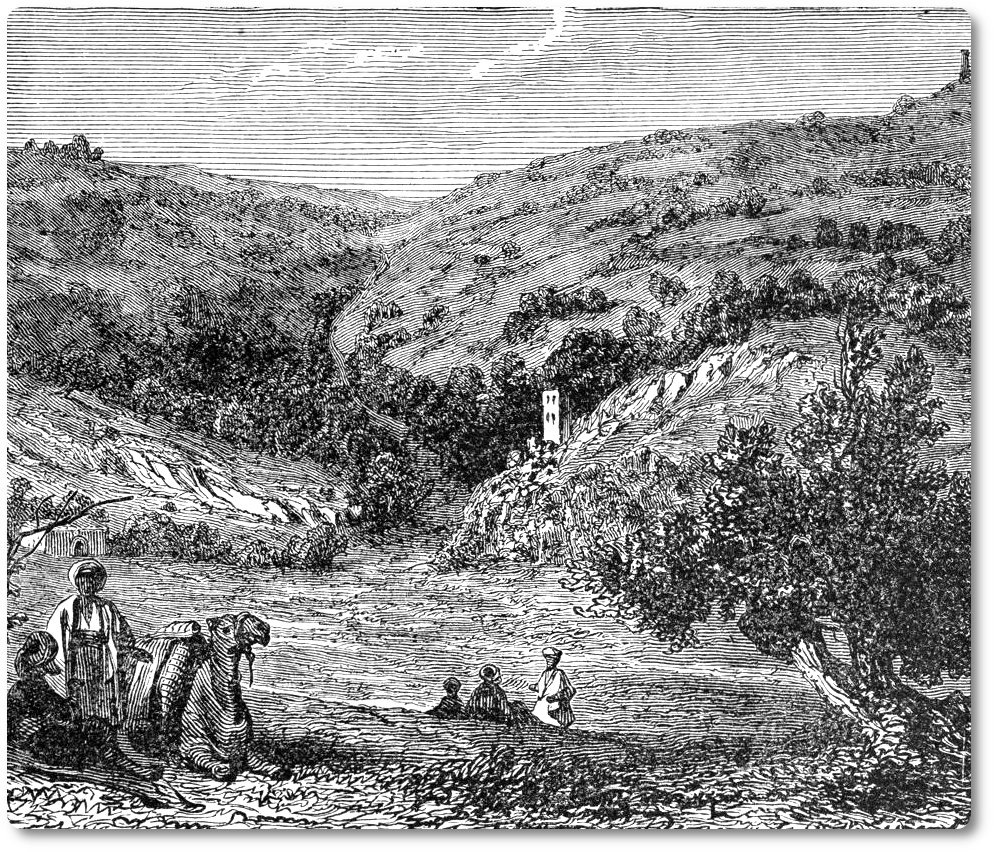
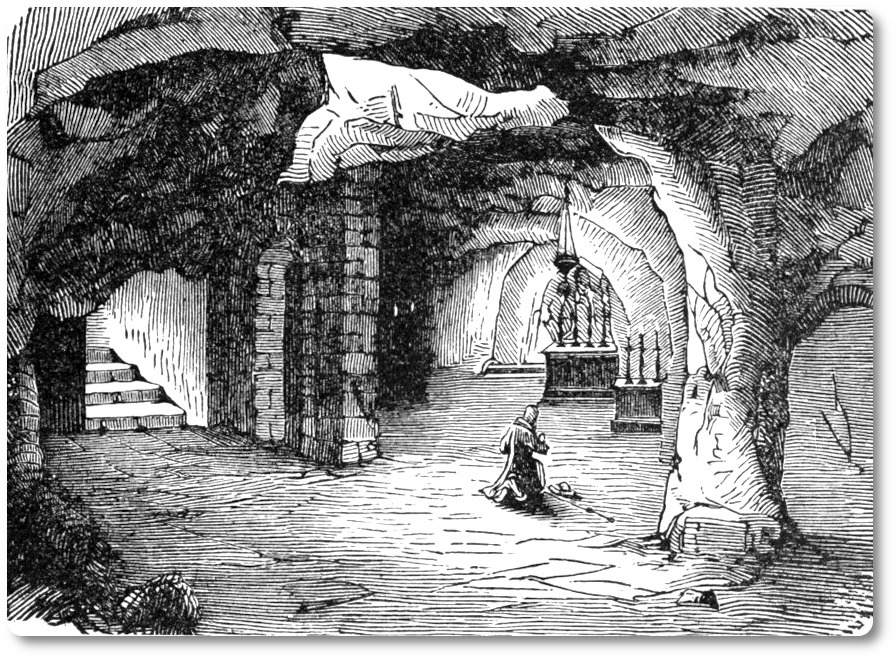
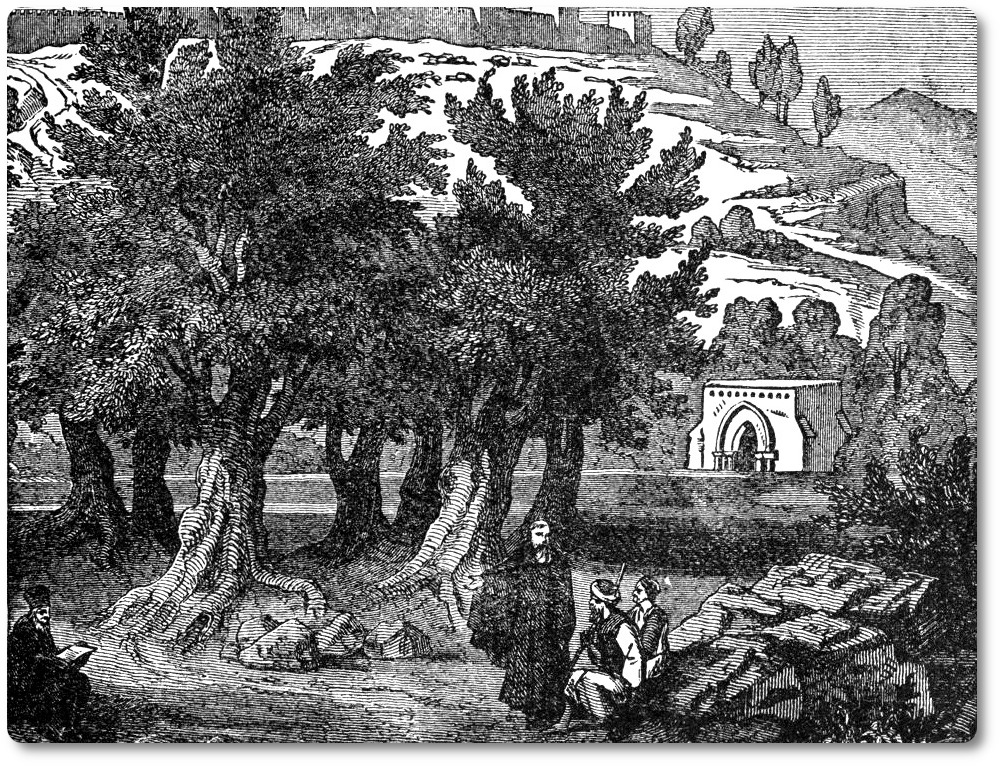
A little east of Jerusalem is the Valley of Josaphat. It is a deep, gloomy ravine between two and three miles in length traversed by the brook Cedron, now a mere rivulet always dried up in summer. On the eastern edge of the valley, lying under the Mount of Olives, is the Garden of Gethsemani, the scene of Our Saviour's agony and bloody sweat. The Franciscan Fathers have purchased and enclosed a great part of the garden. "Within the enclosure is a grotto where Our Lord retired to pray, and where, in His agony, the drops of bloody sweat went trickling down upon the ground. Here is the rock on which the three apostles slept, and here a fragment of a pillar marks the spot where Judas by a kiss betrayed the Son of man. Among about fifty olive-trees in the garden are eight larger and older than the rest ; some of these are nineteen feet in circumference, and reliable persons in such matters state that some of these date back to the days of Our Saviour.
Now let us turn back to the Tomb of the Blessed Virgin. We descend to the tomb by long flights of broad marble steps. On the right, going down, are the tombs of St. Ann and St. Joachim, the parents of the Blessed Virgin, and on the left is the tomb of her spouse, St. Joseph. Still farther down is the vacant tomb of our blessed Mother, where her pure body was laid until it was transplanted into heaven. We pass out of the church, and begin the ascent of the Mount of Olives.
Near the summit of the mountain is a small mosque, and in front of it a small edifice encloses the spot from which Our Lord ascended to heaven. There the impression of His left foot is imprinted on the rock. To the left is a higher part of the hill on which the apostles stood looking up after Our Lord, when the two angels appeared to them.
From the minaret of the mosque just mentioned is afforded a fine view of the city, and of the country for miles around. To the west lies Jerusalem, with its towers, domes, and min arets, its great eastern wall rising out of the Valley of Josaphat.
To the south the heights of Bethlehem are visible ; to the east Judea, a wide expanse of sterile, rocky hills and mountains; farther on the valley of the Jordan ; and at its southern extremity the Dead Sea. Beyond it and the valley of the Jordan are the mountains of Moab and Amnon ; to the north of these the mountains of Gilead.
Every Friday afternoon in Jerusalem all priests in communion with the Holy See make the Stations of the Cross. They meet in the Church of the Holy Sepulchre, whence they proceed in a body to Pilate's palace, where Our Lord was condemned to death, and there begin the Stations. The palace is now a Turkish barrack; in the hall is a marble slab which marks the spot on which Our Saviour stood when He was condemned to death : this is the First Station. The Second is a little below, where once stood the Holy Stairs, now in Rome, down which Our Lord walked, bowed down by the weight of the cross. Near by is a convent of the Sisters of Sion, the chapel of which covers the place where Our Saviour was scourged, and afterwards crowned with thorns. At the back of the altar in this chapel is a part of the Ecce Homo Arch; it was from beneath this arch that Pilate presented Our Lord to the Jews, saying: "Behold the man." Passing into the street, and turning to the left, we reach the Third Station. It is marked by a broken pillar leaning against a wall ; it was here Our Lord fell for the first time. From this we proceed till we come to another street turning to the right ; up this street we find a slab in the wall : the Fourth Station, where Jesus meets His afflicted Mother. Further on in the same street is an excavation in the wall of a house : the Fifth Station, where Simon of Cyrene helped to carry the cross. Near this is the Sixth Station, the house of Veronica, who gave Jesus a towel with which to wipe His face. At the end of the street is the site of the Gate of Judgment : the Seventh Station, where Our Lord fell a second time. A Greek convent occupies the site of the Eighth Station, which is where Our Lord addressed the women of Jerusalem. The street of the Via Dolorosa ends here. The Ninth Station is on a mound on top of which stands a Copt convent ; here a column marks the place where Our Lord fell for the third time. The other five stations are made in the Church of the Holy Sepulchre, and the devotions conclude with Benediction of the Blessed Sacrament given in the Chapel of the Apparition.
The Grotto of the Agony.
Leaving Jerusalem by the Jaffa Gate, let us make our way to Bethlehem. Going down and across the Valley of Hinnom, we leave on our left the Hill of Evil Counsel, the garden of the country-seat of Caiphas, and the tree on which Judas hanged himself. To the right is shown the house of holy Simeon, and further on we find the Well of the Wise Men. Tradition says that the Magi stopped here to refresh themselves, and that the star, which for awhile had disappeared, again shone forth and they saw its image reflected in the water. Nearly a mile before we reach Bethlehem we come to the TOMB or EACHEL. This tomb, now about 3600 years old, is reverenced by Christians, Jews, and Mohammedans. Near here a road branches off to the Pools of Solomon. These pools are three in number, the Upper, Middle, and Lower pools. They are immense reservoirs, and originally supplied with water not only the enclosed garden of Solomon, but the cities of Bethlehem and Jerusalem. The Lower Pool, which is five hundred and eighty-two feet in length, two hundred and seven in breadth, and about fifty deep, would, it is said, float the largest war-vessel. It is wonderful how well preserved these basins are after the lapse of so many centuries. Near the pools is the sealed fountain which Solomon had made specially to supply water for the sacrifices in the temple ; this he sealed so that nothing might pollute the water in its course to the Holy of holies. To the left we see the Field of the Shepherds ; they were ' ' keeping the night-watches over their flocks " when "an angel of the Lord stood by them "and announced, "This day is born to you a Saviour, "Who is Christ the Lord." A grotto marks the place where the angel stood.
Gethsemani.
The Grotto of the Shepherds was at one time the crypt of a church erected on the scene of the apparition by St. Helena.
At last we reach Bethlehem, the birthplace of our Lord and Saviour. It is built over the eastern extremity of a high hill, and besides being one of the oldest is among the most prosperous of all the towns in Palestine. It has a population of about five thousand souls, nearly all Christians, who have successfully resisted Turkish oppression. The people are remarkable for their good looks and their brave spirit. There is one broad street to the village, at the extremity of which stands the magnificent 686 A TEIP TO THE HOLY LAND.
Church of the Nativity, erected in the year 327 by the Empress Helena. The building is well preserved. The walls are covered with mosaics, which are said to date from the building of the church. The roof is made of immense beams of rough cedar brought from Mount Lebanon.
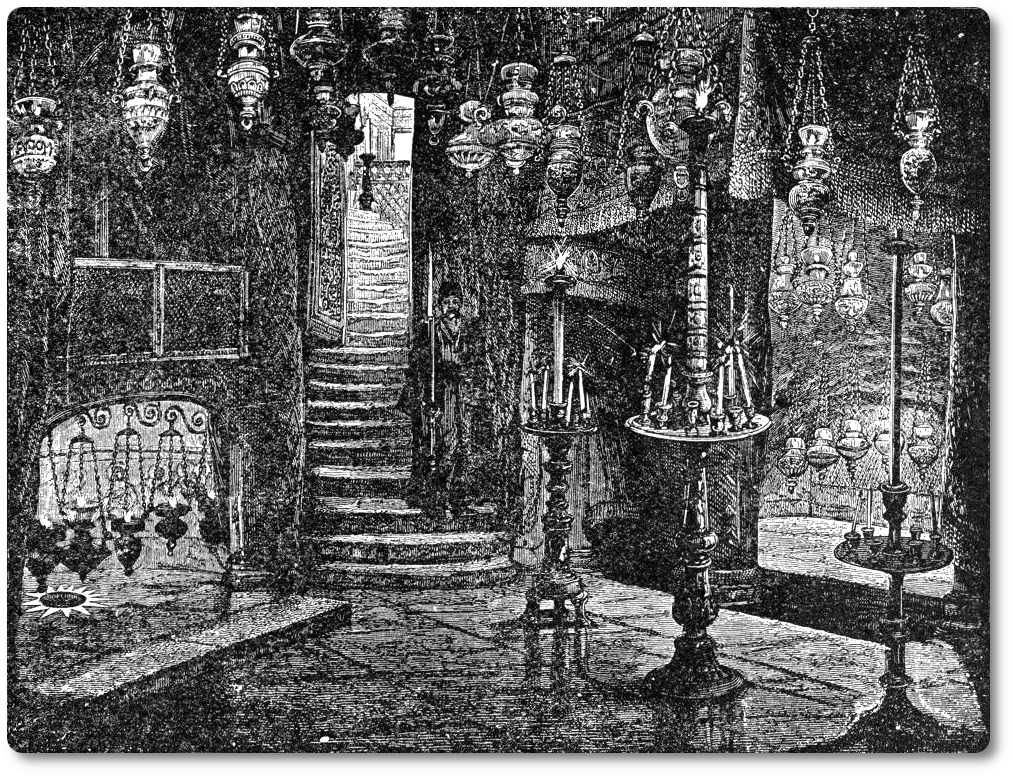
The cave in which Our Saviour was born is below the level of the floor of the church. The walls of this chapel are of marble, hung round with silver lamps, embroidery, and ornaments of various kinds. At the east end is the Altar of the Nativity, and under it is a silver star surrounded by the words, "Hic de Virgine Maria Jesus Christus natus est" — "Here Jesus Christ was born of the Virgin Mary." A large number of lamps, belonging to the Catholics, Greeks, and Armenians, who own the chapel in common, are kept burning constantly. Near this spot is the Chapel of the Manger, and opposite the place of the manger is the Altar of the Wise Men.
Not far from the great basilica which rises over the stable of Bethlehem, and a little to the south of it, is a subterranean chapel known as the Grotto of the Milk. This chapel, although the exclusive property of the Catholics, is much visited by schismatics, Bedouin and Mohammedan women, and they as well as the Catholic women supply the olive-oil which is burned before the altar. According to a pious legend, the Virgin Mother hid herself in this grotto after the angel had appeared to St. Joseph and told him to fly to Egypt. Whilst she nursed the divine Infant, a drop of her milk fell upon the soft stone, and since that time the mothers of that country who cannot nurse their babes come to this grotto, and, scraping off some of the stone, swallow the scraping, and, invoking the intercession of Mary, obtain the privilege they seek.
Leaving Bethlehem, let us pass into the "hill-country " of Judea. About seven miles from Jerusalem, situated on a plain, surrounded by craggy mountains, is Ain Karim, or St. John in the Mountains, the place where St. John the Baptist was born, and where the Blessed Virgin visited her cousin, St. Elizabeth. Although the country is rocky beyond description, yet so fertile is the soil that trees, gardens, and vineyards thrive there with little or no care on the part of the people. Over the spot where St. John was born is a church and monastery. The church contains a picture by Murillo of St. John in the Wilderness.
About a quarter of a mile from the village, upon the side of a hill, is a convent, the country-house of the Sisters of Sion, to the left of which is a church where once stood the house of the visitation. The church stands in the midst of the ruins of a church built by the crusaders. On entering we come face to face with an altar, beneath which is an inscription stating that this is the place where the Blessed Virgin and St. Elizabeth met, and whereon St. Elizabeth pronounced her "blessed among women." Near by this church is a small cave in which St. John the Baptist was concealed during the slaughter of the innocents.
Interior of the Chapel of the Nativity.
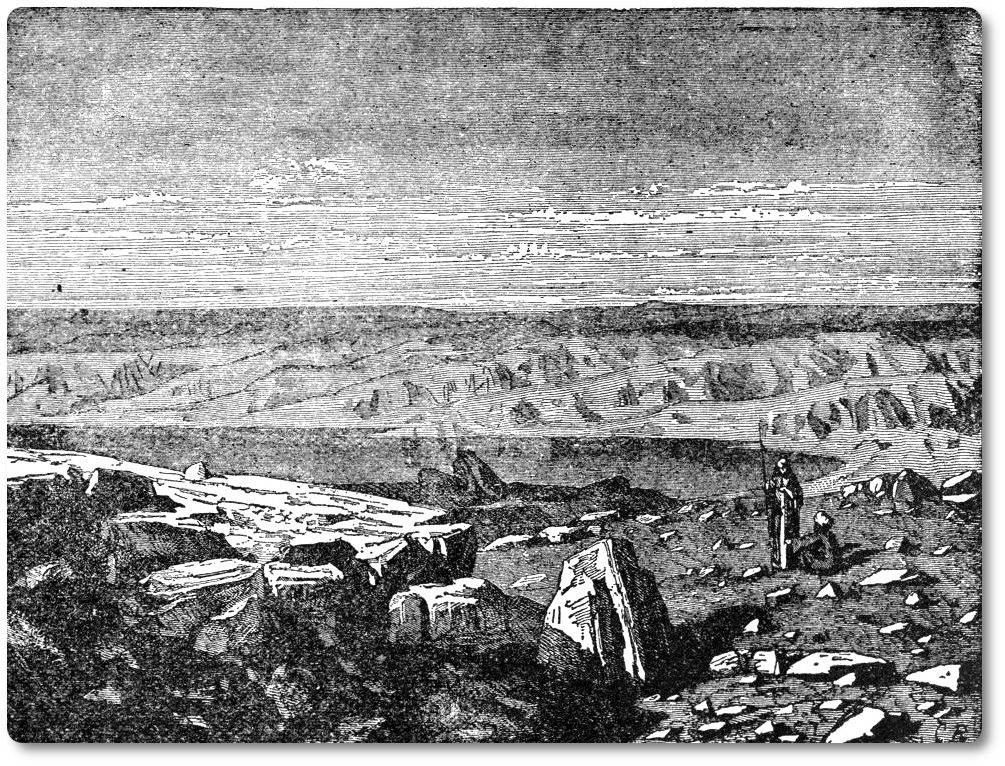
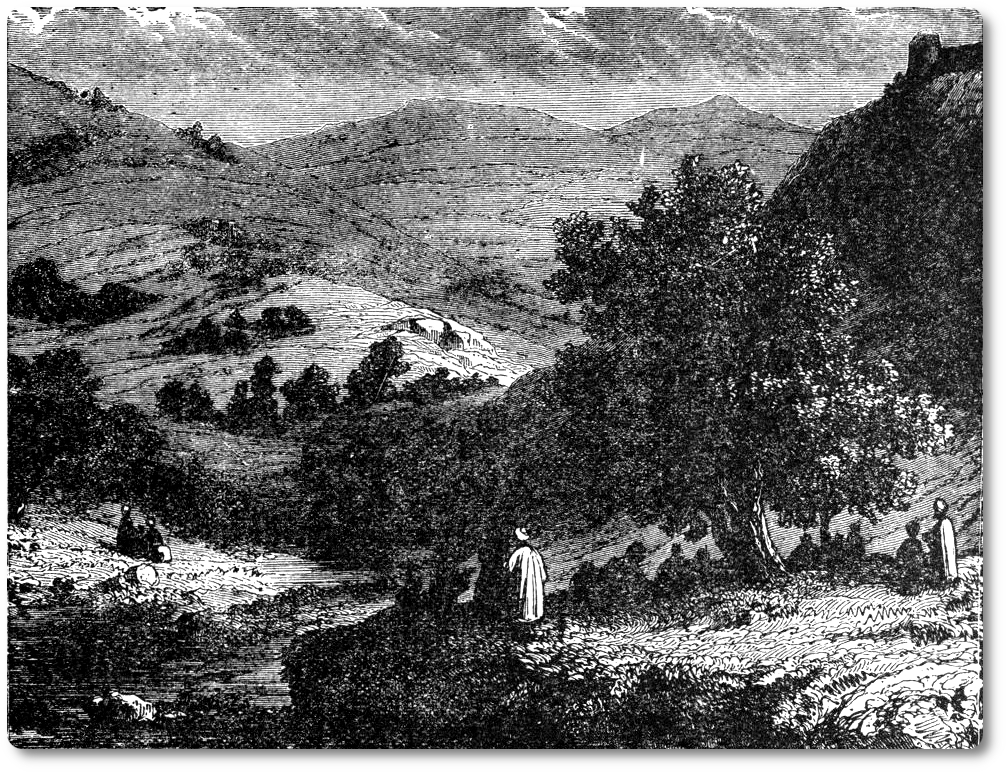
Eeturning to Jerusalem, let us take the road through the Valley of Gihon, following the course of the brook Cedron, and visit the Dead Sea and the Eiver Jordan. After a three hours' ride we come to the famous Convent of Mar Sabas, built on the edge of a precipice, and one of the most picturesque objects in all Palestine. The convent, with its numerous buildings arranged in terraces on the side of the mountain, like the benches of an amphitheatre, and with balconies overhanging the precipice, harmonizes perfectly with the rude grandeur of the surround- ing scenery. The convent was founded by St. Sabas, who was born about the middle of the fifth century. In its early days it was frequently attacked by the Persians, and finally about the beginning of the seventh century it was plundered by them, and its inhabitants, to the number of about four thousand, were massacred. Leaving the convent, we start for the Dead Sea. The scenery is wildly beautiful, and the road for some distance runs dangerously near to a precipice. On our way we pass the supposed Tomb of Moses. A convent, built over the spot in the fourth century, was taken possession of by the Mussulmen, who converted it into a mosque. A short ride from this place brings us to the Dead Sea. The Dead Sea is forty-six miles in length, and, at its broadest part, about ten miles in width. There is no animal life in its waters, though birds fly over and even skim its surface. The River Jordan and some smaller rivers empty themselves into and are lost in this sea, and mountains from fifteen hundred to twenty-five hundred feet in height surround it on all sides. Moving up the River Jordan, an hour's journey brings us to the Pilgrims' Bathing Place. There is very little doubt that it was at this place the Israelites crossed the Jordan to enter the land of promise, and here Elias and Eliseus crossed the Jordan dry-footed, and it is the constant tradition of every age and race that it was here that our blessed Lord was baptized by St. John.
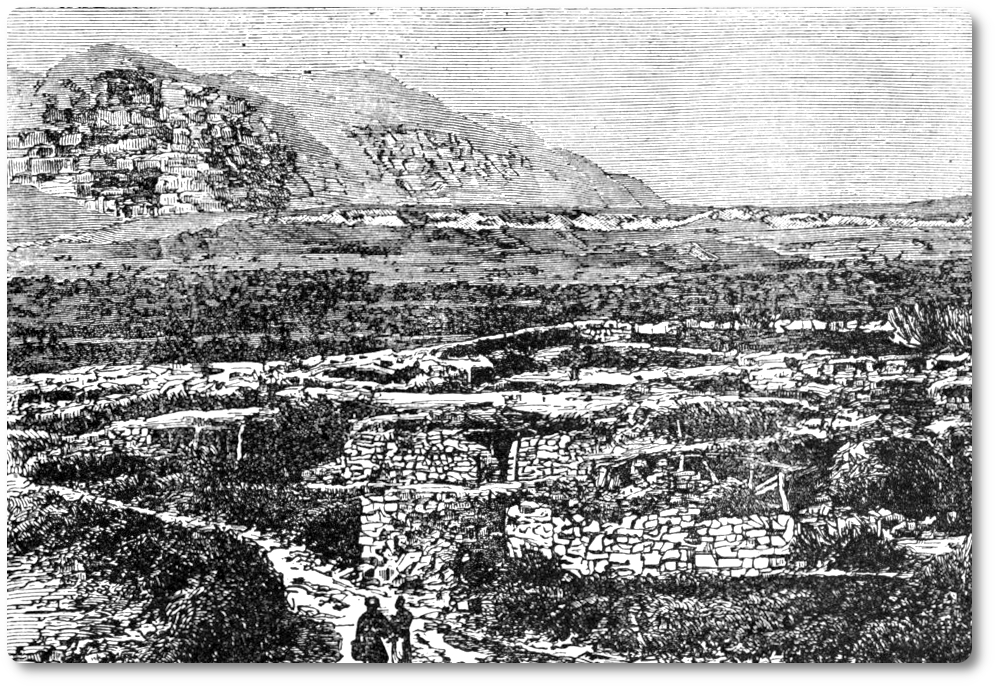
Leaving the Jordan behind us we move toward Jericho, * c the city of palm-trees," as Moses described it when, looking down from Mount Nebo, he saw it stretched out before him. In this neighborhood took place many of the events described in the lives of the prophets Elias and Eliseus. Here David crossed the Jordan when fleeing from Absalom. Near here St. John preached penance. About two miles to the north rises the barren, desolate Mountain of Temptation, where Christ fasted for forty days, and was afterward tempted by the devil. Here He was a guest at the house of Zacheus, and from here He began His last, sad journey toward Jerusalem. The place is now nothing but a heap of ruins. Among these stands a large building, now occupied as a barrack, said to be built over the house of Zacheus.
About ten miles north of Jerusalem on the road to Samaria is the site of the ancient town of Bethel, once a well-known city and holy place, now a miserable village covering three or four acres on a hill-summit. It was at Bethel that Jacob in his sleep had the vision of the ladder on which angels were ascending to heaven and descending therefrom. It was then that he changed the name of the place from Luza to Bethel, which means "the house of God." It was here that Samuel administered justice to the people of Israel every year ; here Jeroboam raised a golden calf and offered sacrifice to it ; and it was on the road from Jericho to Bethel that the bears came out of the forest, and tore the forty-two boys who were mocking the prophet Eliseus. On the north of Bethel may be seen the rocky heights which bound the heritage of Benjamin, separating it from that of Ephraim. To the south can be seen the heights of Jerusalem, and just the summit of Mount Olivet. To the south and southwest are the villages of Gibeon, Gibeah, and Giba. The Valley of Bethoron is also visible from Bethel. It is memorable as the scene of Josue's victory over the five kings of the Amorrhites, and of the victory of Judas Machabeus over the Syrians. The road connecting the upper and the lower Bethoron is still "the great road of communication and heavy transport between Jerusalem and the seacoast." Proceeding northward, we take the road to Silo, passing through a pleasant valley fertile in olive groves and fig orchards. Silo, once a famous place, is now a ruin. There the boy Samuel was taken to minister before the Lord. From there the Ark of the Covenant was sent to the camp of the Israelites with the hope of retrieving their fortunes in the battle won by the Philistines near Bethoron. The ancient ruins on the plateau, where once stood the Ark of the Covenant, are now scattered about in confusion. Proceeding over a beautiful plain we reach Jacob's Well. It was by this well Our Saviour was seated when the Samaritan woman came to draw water. It is one of the localities connected with the life of Our Lord which is undisputed. Formerly there was a square hole opening into a carefully built vaulted chamber, about ten feet square, in the floor of which was the mouth of the well. Now a part of the vault has fallen in and completely covered up the mouth, so that nothing can be seen but a shallow pit half filled with stones and rubbish. The well is about seventy-five feet deep, and while it sometimes contains a few feet of water, at other times it is perfectly dry. It is entirely excavated in the solid rock, perfectly round, nine feet in diameter, with the sides hewn smooth and regular.
The Dead Sea.
From Jacob's Well we proceed to Sichem, an important place in Jewish history. The situation of the town is one of great beauty. It lies in a sheltered valley protected by Mount Garizim on the south, and Hebal or Ebal on the north. The feet of these mountains where they rise from the town are not more than five hundred yards apart. The bottom of the valley is about eighteen hundred feet above the level of the sea, and the top of Garizim eight hundred feet higher still. The site of the present city, which is called Nabulus, believed to have been also that of the Hebrew city, is exactly on the water-summit ; and streams issuing from the numerous springs there flow down the opposite slopes of the valley, spreading verdure and fertility in every direction, and making the place the paradise of the Holy Land. The place is the seat of an active commerce, and of a comparative luxury to be found in very few of the inland oriental cities. Its population consists of Mohammedans, Greek Christians, Samaritans, and Jews. The enmity between the Samaritans and the Jews is as inveterate still as it was in the days of Our Saviour, when the former refused Him admission A TEIP TO THE HOLY LAND. 691 into one of their cities, "because His face was of one going to Jerusalem," or, in other words, because He was going to Jerusalem. The mountains Garizim and Ebal are remarkable from the fact that owing to their strange formation persons standing in the plain can hear distinctly every word that is spoken on the top of either mountain. It was these mountains that were chosen by Josue for the first assembly of the Israelites, half of the people being marshalled on one side and half on the other. Leaving Mount Garizim, let us follow the road that leads to Samaria. The village stands on a hill ; it is tolerably built, and is covered with fine gardens and plantations, interspersed with numerous remains of antiquity, such as the ruins of a church dating back in all probability to the time of the apostles, some columns of a temple, and portions of a long colonnade, supposed to have been erected by Herod the Great. Samaria was founded by Amri, the sixth King of Israel, and until the Captivity, B.C. 720, it continued to be the capital of the ten tribes of Israel, It afterwards gave name to the province of Samaria.
Jericho.
Leaving Samaria, let us move on to Mount Carmel. This famous mountain forms the extremity of a range of hills which extend northwest from the plain of Esdraelon, rounding the Bay of Acre on its south side, and terminating in a steep prom- ontory in the Mediterranean. It is about fifteen hundred feet in height ; its summit is covered by pines and oaks, and further down are olives and laurels. Modern travellers delight to describe the rocky dells of Mount Carmel, with its deep jungles of copse, its shrubberies thicker than any others in central Palestine, its impenetrable brushwood of oaks and evergreens, tenanted in the wilder parts by a profusion of game, but in other places "bright with hollyhocks, jasmine, and various flowering creepers." It was on Mount Carmel that the prophet Elias called down fire from heaven, and confounded the priests of Baal, and showed the power of God. Afterward by imploring God's aid he caused rain to fall on the parched land. The place of the sacrifice of Elias is still pointed out, and the convent and church of the Carmelite Fathers is built over the cave in which the prophet dwelt. The convent is a square two-story building, and will accommodate seventy-five pilgrims. The most remarkable places outside the church and convent are the School of the Prophets, the Valley of the Martyrs, and the Fountain of Elias. The Holy Family, it is said, dwelt at the School of the Prophets, while they were at Carmel, on their return from Egypt. It is only a cave in the side of the mountain between the convent and the seashore. The Valley of the Martyrs is a plain about a mile south of the convent, and near it is the Fountain of Elias.
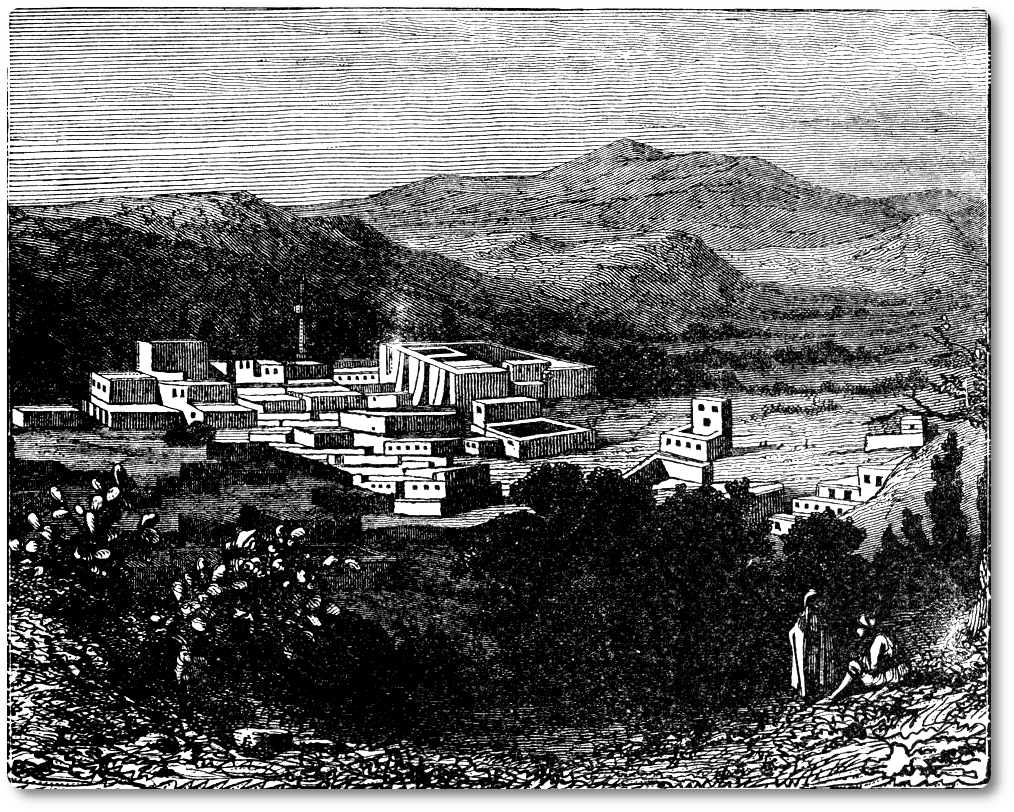
About eighteen miles from Haifa, which is the town below Mount Carmel, is Nazareth. The town is situated among the hills which constitute the south ridge of Lebanon, just before they sink down into the plain of Esdraelon. It contains about three or four thousand inhabitants, a few of them Mohammedans, but most Greek or Catholic Christians. Most of the houses are well built, of stone, and appear neat and comfortable. The streets are narrow and crooked, and after a rain are almost impassable on account of the mud. The first building we meet on entering Nazareth from the south is the Church of the Annunciation. In architectural design and artistic finish it is one of the finest churches in Palestine. The high altar, dedicated to the archangel Gabriel, is reached by marble steps on either side. Beneath it is the crypt, which is reached by a broad flight of fifteen marble steps. Here is the Holy grotto, called the Chapel of the Annunciation. In this grotto stands a marble altar ded- icated to the Blessed Virgin, and on the stone under it is the inscription, "Hic Verbum caro factum est" —"Here the Word was made flesh." On the right and left of the altar are columns which mark the places where the archangel and the Blessed Virgin stood during their interview, and close by is the tomb of St. Joseph. The Holy House of Nazareth itself is, as our readers well know, now in the city of Loretto, Italy. When the Turks conquered Palestine, the Holy House was, to all appearances, doomed to destruction. But an all-powerful Providence intervened, and in a most miraculous manner preserved this sacred relic. Early in the morning of May 10, 1291, the inhabitants of Dalmatia were astonished to find resting on a hill midway between Tersate and Fiume, two towns near the coast of the Adriatic, a small house which had never been seen there before. It was built of a red sandstone entirely unknown in that country, and, without foundation, was resting on the bare ground. It had but one door with one beam for door-posts, and but one small window. On the inner walls were several paintings, though much effaced and neglected. The ceiling was painted 694 A TRIP TO THE HOLT LAND. blue and studded here and there with stars. In one end stood a stone altar and above it an image of the crucifixion. On one side of the altar, in a niche, was an image of the Blessed Virgin ; on the other side was a closet containing a few earthen vessels. While the wondering crowds stood gazing and discussing the strange event, the parish priest of the place appeared on the scene. This was another surprise, for he had been confined to his bed for the three years previous by a severe attack of dropsy. To the eager listeners this venerable pastor, whose name was Alex ander di Giorgi, declared that during the previous night the Blessed Virgin had appeared to him in a dream and assured him that this unknown building was no other than the house in which she had dwelt at Nazareth ; that the altar was the same erected by St. Peter ; and that the crucifix and statue, both of cedarwood, had been made by St. Luke. In proof of the truth of her words the vision promised him complete recovery from his illness, and, as they could see for themselves, such recovery had taken place. On hearing these words the astonishment of the people was turned to joy, and with feelings of deepest gratitude the simple peasants knelt down and venerated the precious relic. As the news spread multitudes of curious and pious Christians came from surrounding districts. But, strange to say, after the space of three years and seven months, on December 10, 1294, the Holy House disappeared one night as strangely and suddenly as it had come, and was carried by angels over the Adriatic Sea to Ancona, in Italy, and set down in the midst of a grove of laurel-trees. From lauretum, the Latin term for laurel, the place has come to be called Loretto.
Nazareth-
Leaving the Church of the Annunciation, let us visit the Fountain of the Blessed Virgin, so called because tradition has it that our blessed Lady came daily to draw water from it. Being the only spring in the place, it has to supply all the inhabitants, and yet has never been known to fail. The people of every class and creed have the greatest veneration for it. From the fountain let us go to the Workshop of St. Joseph, situated to the northeast of the Church of the Assumption. It is a plain, small building, of which only a portion of the original walls still remain, the most of it being rebuilt. The site and chapel attached now belong to the Franciscans. The chapel is an humble one, but it has a beautiful marble altar, beneath which is A TEIP TO THE HOLT LAND. inscribed, "Hic erat subditus illis" — "Here He was subject to them." In the western and upper part of the town is the Chapel of Mensa Christi, or "Table of Christ." On the floor is a large stone on which, according to tradition, our blessed Lord ate with His apostles both before and after His resurrection. About two miles outside the town of Nazareth is the Mount of Precipitation, where the Nazarenes brought Our Saviour that they might cast Him down headlong.
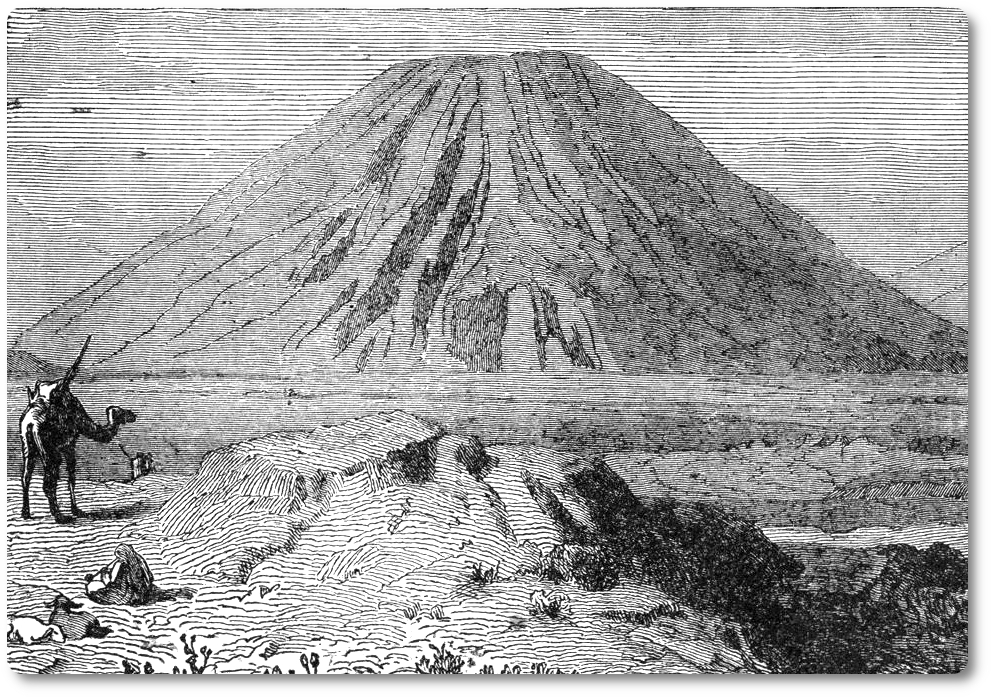
About six or eight miles almost due east from Nazareth is Mount Thabor. It rises about a thousand feet above the level of the plain, and as seen from a distance is beautiful and symmetrical in its proportions. The body of the mountain is of the limestone peculiar to the country ; on it is a comparatively dense forest of oaks, and other trees and bushes, with an occasional opening on the sides, and a small uneven tract on the summit. It takes about an hour, over a steep and circuitous path, to reach the top, which consists of an irregular platform, embracing a circuit of half an hour's walk, and commanding extensive and beautiful views. On the east may be seen the entire outline of the Sea of Tiberias and some of its waters, the course of the Jordan for miles, the fortresslike mountains of Hauran, and the mountains of Gilead and Bashan ; Hermon and intervening hills on the north and northeast, Carmel on the northwest ; on the west the Mediterranean and the plains of Galilee ; on the south Gilboa, Endor, and Naim. All around the top of Mount Thabor are the foundations of a thick wall built of large stones, some of which are bevelled, showing that the entire wall was originally of that character. In several parts are the remains of towers and bastions. The chief remains are upon the ledge of rocks on the south of the little basin, and especially toward its eastern end; here are, in indiscriminate confusion, walls, and arches, and foundations apparently of dwelling-houses, as well as other buildings, some of hewn and some of large bevelled stones. The walls and traces of a fortress are seen here, and further west along the south ern brow, of which one tall pointed arch of a Saracenic gateway is still standing, and bears the name of Bab-el-Hawa, "Gate of the Wind." Tradition points to Mount Thabor as the scene of the transfiguration of Our Lord, which is described in the ninth chapter of the Gospel of St. Mark. There is a beautiful church on the spot where Our Lord was transfigured, and near by is the Franciscan convent. There is an abundance of pure spring-water on the mountain, and rich cornfields and luxuriant vineyards, while herds of sheep and goats graze on its sides. On the top is a cave said to have been inhabited by Melchisedech.
Mount Thabor.
In the immediate neighborhood of Mount Thabor are Naim and Endor, the one memorable as the scene of the restoring to life of the widow's son, the other as the place where Saul on the eve of his last engagement with the Philistines consulted a witch, a woman who had "a divining spirit."
About four and a half miles northeast of Nazareth is Cana. It is situated on a broad hillock, and is surrounded by olive groves and fig orchards. It was at Cana that Our Lord performed His first miracle, changing water into wine. There are two churches here, and each claims to be built over the house in which this miracle took place. Besides, one claims to have in its possession one of the water-pots used in the miracle.
From Cana let us make our way to the Mount of Beatitudes, which is on the road to Tiberias. The mount — for it is not high enough to be dignified by the name of mountain — stands in the centre of an immense rocky plain. It was from this place that our blessed Saviour delivered His sermon, which is recorded in St. Matthew, chapters v., vi., and vii., and near by is the scene of the miracle of the loaves and fishes.
Three miles further on we reach Tiberias on the shore of the Sea of Galilee. It was on the border of this sea that our blessed Lord showed Himself to His disciples for the third time after His resurrection, and here it was that He commissioned St. Peter to feed His lambs and His sheep. The Lake of Tiberias, often mentioned in the New Testament, is also called the Lake of Genesareth, the Lake of Capharnaum, the Sea of Galilee. Numerous cities once existed along its shores and its waters were white with sails. Tiberias, in the days of Our Lord, was a large city and the seat of the province of Galilee. It no longer exists, the present city of the name being three miles further north. Two other once famous cities, Capharnaum and Bethsaida, also stood on the Lake of Tiberias. The main interest attaching to Capharnaum is as the residence of Our Lord and His apostles, the scene of many of His miracles. It was there that the man troubled by the unclean spirit was cured, that the other man sick of the palsy was made well, that the servant of the centurion was healed. Bethsaida was the birthplace of the apostles Peter, Philip, and Andrew. The doom which Our Lord pronounced against Capharnaum, Bethsaida, and Corozain (Matt, xi.) has been literally fulfilled, for there is hardly a stone left upon a stone to mark the places where they once stood.
The River Jordan.
Before closing this sketch let us take a look at Tyre and Sidon. Ancient Tyre was one of the most celebrated cities of antiquity, and the most important city of Phenicia. It is first mentioned in the Bible in Josue xix. 29 as "the strong city." Further on we find that Hiram, King of Tyre, sent cedarwood and workmen to King David to build for him a palace. Tyre was noted for its skill in the mechanical arts for we learn from iii. Kings v. that Hiram sent his sailors and servants to help Solomon in building the temple. Filled with pride at its riches and prosperity, Tyre called down on itself the curse of the Almighty. Time and again it was destroyed only to spring to life again, but in the thirteenth century its glory departed forever. In the city that stands on the site of ancient Tyre may still be seen, scattered here and there, shafts of gray and red granite, capitals of many-colored marble, and other remains of ancient glory. It was at Tyre that Our Lord healed the daughter of the woman of Chanaan, and St. Paul visited the city on his way to Jerusalem. Twenty miles from Tyre is its ancient rival Sidon. Its people were noted for their skill as mechanics, manufacturers, and navigators. Like Tyre this city was ruined by its prosperity. As our purpose is more to consider the Holy Land in connection with the life of Our Lord, we shall dismiss Sidon, merely remarking that it was the scene of one of Our Saviour's miracles, which is thus recorded in the Gospel of St. Mark vii. 31-35: "Going out of the coasts of Tyre, He came by Sidon to the Sea of Galilee through the midst of the coasts of Decapolis. And they bring to Him one deaf and dumb ; and they besought Him that He would lay His hand upon him. And taking him from the multitude apart, He put His fingers into his ears, and spitting, He touched his tongue. And looking up to heaven, He groaned, and said to him : Ephpheta, which is, Be thou opened. And immediately his ears were opened, and the string of his tongue was loosed, and he spoke right."
|