
Fr. Junípero Serra (1713-1784). Miguel José Serra was born November 24, 1713, at Petra on the island of Mallorca, the son of farmers. He entered the Franciscan Order in 1730, taking the name Junípero after a companion of St. Francis, and after his ordination he taught philosophy and theology, holding the chair of Scotist theology at the Lullian University in Palma. In 1749 he left the university for the missions of America. He worked first among the Pame people of the Sierra Gorda in Mexico (1750-1758), then from the Franciscan College of San Fernando in Mexico City, and in 1767 he was appointed president of the former Jesuit missions of Baja California.
In 1769 Fr. Serra went north with the Portolá expedition as president of the missions of Alta California. Between 1769 and 1782 he founded the first nine of the twenty-one missions, from San Diego de Alcala to San Buenaventura, with his headquarters at Carmel. He died at Carmel on August 28, 1784, and is buried there in the mission church.
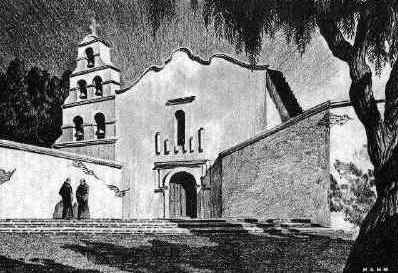 San Diego de Alcala (1769) Founded July 16, 1769, by Fr. Junípero Serra on Presidio Hill above San Diego Bay, the first of the twenty-one Franciscan missions of Alta California. The surrounding country belonged to the Kumeyaay, whom the Spaniards called Diegueño after the mission's patron. In August 1774 the mission was moved six miles inland to its present site in the San Diego River valley, near the Kumeyaay village of Nipaguay. On the night of November 4-5, 1775, warriors from a number of Kumeyaay villages burned the mission; Fr. Luis Jayme, one of its two missionaries, was killed, the first missionary death in Alta California. Fr. Serra returned and rebuilt the mission in 1777. At its peak the mission ran some 20,000 sheep, 10,000 cattle, and 1,250 horses. The fourth church on the site, begun in 1808 with buttressed walls against earthquakes, was dedicated November 12, 1813. The mission was secularized by the Mexican government in 1834; the buildings later served as a U.S. Army post (1850-1857), and the mission lands were restored to the Church by order of President Lincoln in 1862. The present church, a reconstruction of the 1813 building completed in 1931, is an active parish of the Diocese of San Diego. |
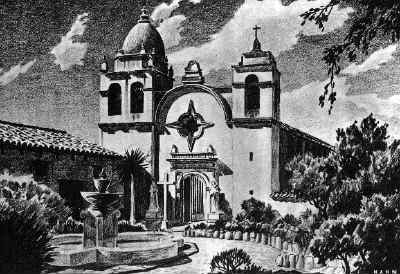 San Carlos Borroméo De Carmelo (1770) Founded June 3, 1770, by Fr. Junípero Serra at Monterey, the second of the twenty-one missions; the next year Fr. Serra moved it to its present site at the mouth of the Carmel Valley, five miles from the presidio. It is named for St. Charles Borromeo, the sixteenth-century cardinal and archbishop of Milan. The mission served the Ohlone (Costeño) and Esselen peoples of the Monterey Bay area. Carmel was Fr. Serra's headquarters and his home; he died there on August 28, 1784, and is buried in the church, with Fr. Fermín Lasuén, his successor, later laid beside him. The present stone church, designed by Manuel Ruiz, was begun in 1793 and dedicated in 1797. Secularized in 1834, the mission was abandoned and its roof fell in; the property was returned to the Church in 1859. Restoration under Harry Downie began in the 1930s. The mission became a parish church in 1933. It preserves Fr. Serra's cell and California's first library. |
 San Gabriel Arcángel (1771) Founded September 8, 1771, by Fathers Pedro Cambón and Ángel Somera, the fourth mission. It is named for the Archangel Gabriel. The people of the area were the Tongva, called Gabrieleño by the Spaniards. In 1775 the mission was moved five miles to its present site to escape floods, and from San Gabriel a party of padres and settlers set out in 1781 to found the pueblo of Los Angeles. The present stone church, begun in 1779 and finished in 1805, was damaged by the earthquakes of 1812, which destroyed the bell tower; a campanario took its place in 1828. Secularized in 1834, the mission was returned to the Franciscans in 1843 and became a parish under the bishop in 1854. The Claretian fathers have maintained it since 1908. The 1987 earthquake closed the church until 1993. San Gabriel was known in its day as the Pride of the Missions. |
 San Antonio de Padua (1771) Founded July 14, 1771, by Fr. Serra, the third mission, in a valley of the Santa Lucia Mountains. It is named for St. Anthony of Padua. The people of the valley were Salinan. Fr. Buenaventura Sitjar, who served the mission for thirty-seven years, compiled a grammar and dictionary of the local language. The church of 1781 had, by Fr. Serra's account, the first tile roof on any California church, and in 1806 the mission completed California's first water-powered grist mill. The present church dates from 1810-1813. Secularized in 1834, the mission was offered for sale in 1845 and found no buyer. It was returned to the Church in 1851, then abandoned again after 1882. A complete rebuilding began in 1948, financed by the Hearst Foundation and directed by Harry Downie, with Salinan descendants of the mission's builders taking part. Franciscans have been in residence ever since, and the mission remains an active parish in a rural setting much as it was in mission days. |
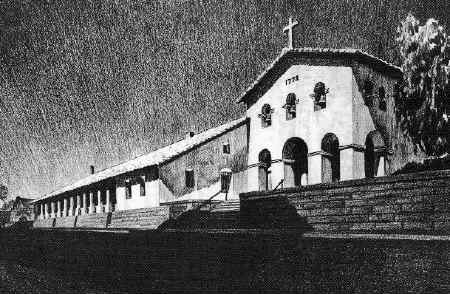 San Luis Obispo de Tolosa (1772) Founded September 1, 1772, by Fr. Serra, the fifth mission, in the valley Portolá had named La Cañada de los Osos (Valley of the Bears). It is named for St. Louis, the Franciscan bishop of Toulouse. The people of the area were the Obispeño Chumash. In 1776 flaming arrows set fire to the thatched roofs and destroyed many of the buildings; tile roofs followed. The present church was built in 1792-1794, and Fr. Luís Antonio Martínez served the mission for thirty-four years from 1796. Secularized in 1835, its lands sold in 1845 for $510, the mission was returned to the Church in 1859. In the 1880s a pastor modernized the church with wooden siding and a steeple; restoration begun in 1933 removed them and rebuilt the bell tower. It remains an active parish, facing the plaza of the city that grew up around it. |
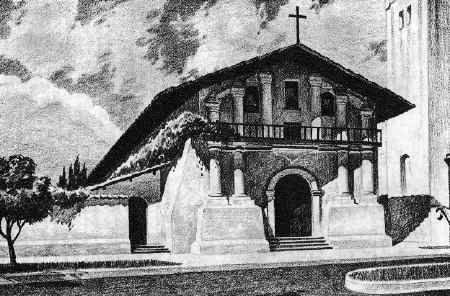 San Francisco de Asís (1776) Founded October 9, 1776, by Fr. Francisco Palóu, the sixth mission, on ground Juan Bautista de Anza had chosen beside a stream named for Our Lady of Sorrows, from which comes its common name, Mission Dolores. It is named for St. Francis of Assisi. The people of the San Francisco peninsula were Ohlone (Costeño). The present adobe church was dedicated on August 2, 1791. Secularized in 1834, the mission saw its lands sold and its grounds used for bull-and-bear fights and horse racing; it was returned to the Church in 1857. The church survived the 1906 earthquake that destroyed the larger basilica beside it, and it stands today much as it was built, the oldest building in San Francisco, keeping its original altar and the mission cemetery. |
 San Juan Capistrano (1776) Founded November 1, 1776, by Fr. Serra, the seventh mission. Fr. Lasuén had first dedicated the site a year earlier, but work stopped when word came of the burning of Mission San Diego, and the bells were buried for safekeeping; Fr. Serra found the cross still standing, and the bells were dug up and hung from a tree. The mission is named for St. John of Capistrano. The people of the area were the Acjachemen, called Juaneño. The Great Stone Church, begun in 1796, was destroyed by the earthquake of December 1812, which killed many of the mission people gathered inside; services returned to the adobe Serra Chapel of 1777. Secularized in 1833 and sold by the governor in 1845, the mission was returned to the Church in 1865. The ruins of the Great Stone Church were never rebuilt; Fr. St. John O'Sullivan restored the Serra Chapel, thought to be the only building still standing in which Fr. Serra preached. The mission is known for the swallows that return each year around March 19, St. Joseph's Day. |
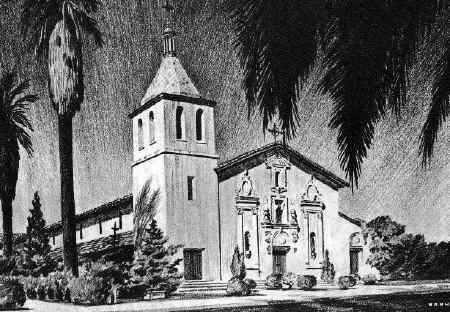 Santa Clara de Asís (1777) Founded January 12, 1777, by Fr. Serra, the eighth mission, near the south end of San Francisco Bay on a site Anza had chosen. It is named for St. Clare of Assisi. The mission served the Ohlone (Costeño) people of the South Bay and, as recruitment reached inland, Yokuts and Miwok people as well. Floods and earthquakes forced repeated rebuilding; the fifth church was completed in 1825. Fr. Magín Catalá, called the Holy Man of Santa Clara, served there for thirty-six years. Secularized in 1836, the church continued as a parish, and in 1851 it passed to the Jesuits, who founded beside it the college that became Santa Clara University. Fire destroyed the church in 1926; the present building, erected in 1929, is a modern reconstruction of the 1825 church. The cross planted at the founding in 1777 still stands across from the entrance. |
 San Buenaventura (1782) Founded March 31, 1782, by Fr. Serra, the ninth mission and the last he founded; he had wanted the site for the third mission as early as 1770 but was refused by the governor. It is named for St. Bonaventure. The people of the area were the Ventureño Chumash, noted boat builders and wood carvers. An aqueduct built in 1790 brought water from the hills. The stone church, begun in 1794, took fifteen years to build; damaged by the earthquake of 1812, it was rebuilt with stone buttresses in 1816. Secularized in 1836, rented and then sold by the governor, the mission was returned to the Church in 1862. A pastor's remodeling in 1893 stripped the interior; restoration begun in 1957 brought the church back toward its early form. It remains an active parish near the ocean. |
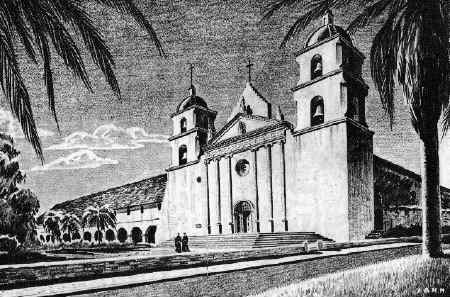 Santa Barbara (1786) Founded December 4, 1786, by Fr. Fermín Lasuén, the tenth mission, on the feast of St. Barbara. Fr. Serra had sought a mission there since 1769, but the governor allowed only a presidio and chapel, and the mission came two years after Fr. Serra's death. The people of the area were the Barbareño Chumash, who built the successive churches. The present church, directed by Fr. Antonio Ripoll, was built from 1815 to 1820 after the earthquake of 1812 damaged its predecessor. Secularized in 1835, the buildings stayed in Church hands and in continuous use; Santa Barbara is the only mission to have remained in Franciscan keeping without interruption. The friars' seminary there ran from 1896 to 1968, and the mission remains a Franciscan parish. Its twin-towered church, called the Queen of the Missions, looks much as it did at its dedication in 1820. |
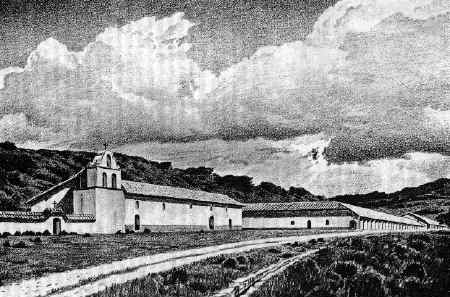 La Purísima Concepción (1787) Founded December 8, 1787, by Fr. Lasuén, the eleventh mission, in an inland valley near the middle of the chain. It is named for the Immaculate Conception of Mary. The people of the area were the Puriseño Chumash. The earthquake of December 1812 destroyed the original buildings, and the mission was rebuilt on its present site across the river, its buildings set in a line rather than a quadrangle. Fr. Mariano Payéras served there nineteen years. In 1824 the mission was caught in the Chumash revolt that also struck Santa Inés and Santa Barbara, and fighting damaged the buildings. Secularized in 1834 and sold in 1845, the mission was returned to the Church in 1874 but lay in ruins. The State of California acquired the site in 1934, and the Civilian Conservation Corps rebuilt it over seven years. Dedicated as a state historic park in 1941, it was then the largest restoration of its kind in the West, and it gives the most complete picture of daily life in mission days. |
 Santa Cruz (1791) Founded August 28, 1791, by Fr. Lasuén, the twelfth mission, near the mouth of the San Lorenzo River. Its full name is La Exaltación de la Santa Cruz, the Exaltation of the Holy Cross. The mission served the Awaswas-speaking Ohlone of the coast and later Mutsun and Yokuts people; its population was always small. The church was completed in 1794 on higher ground after floods. The pueblo of Branciforte, founded next door in 1796, brought continuing trouble: when the mission was emptied in 1818 under threat of the pirate Bouchard, the Branciforte residents left to guard it looted it themselves. Secularized in 1834, the church lost its bell tower in 1840 and fell after the earthquake of 1857; the mission was returned to the Church in 1859. The site is now occupied by Holy Cross parish church. A half-size replica of the mission church, built in 1931, stands nearby, and the one surviving original building, an 1824 adobe that housed mission Indian families, is preserved in the state park system, the only mission Indian housing known to survive. |
 Nuestra Senora de la Soledad (1791) Founded October 9, 1791, by Fr. Lasuén, the thirteenth mission, in the Salinas Valley as a halfway stop between San Antonio and Carmel. It is named for Our Lady in her solitude (Nuestra Senora Dolorosisima de la Soledad). The mission served the Chalon, an Ohlone people of the valley, and neighboring Salinan. Floods from the river destroyed its churches in 1824, 1828, and 1832, and the mission never prospered. Secularized in 1834, it was abandoned after the death of Fr. Sarría in 1835, sold in 1846, and returned to the Church in 1859 but left deserted. For nearly a century only ruins stood. The Native Daughters of the Golden West rebuilt the chapel in 1954 from adobe made of the old walls, and the residence wing followed in 1963. Services are held a few times a year. |
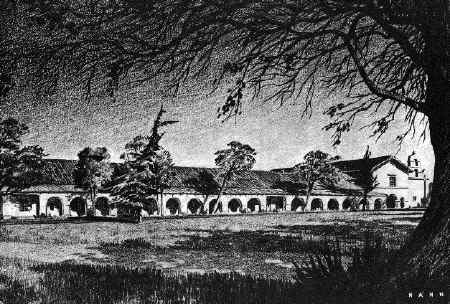 San Juan Bautista (1797) Founded June 24, 1797, by Fr. Lasuén, the fifteenth mission, on the feast of its patron, St. John the Baptist. The mission served the Mutsun-speaking Ohlone and, later, Yokuts people. Its church, dedicated in 1812, was begun with three aisles, but earthquakes persuaded Fr. Felipe Arroyo de la Cuesta to fill in the arches, one reason the church survived 1906 with little damage. Fr. Arroyo compiled vocabularies in seven native dialects, and Fr. Estévan Tápis trained a mission choir and orchestra. Secularized in 1835, the mission continued as a parish, and fifty-five acres were returned to the Church in 1859. The church has been in continuous use. The plaza before it, with its nineteenth-century buildings, is a state historic park, and a surviving stretch of El Camino Real passes beside the cemetery. |
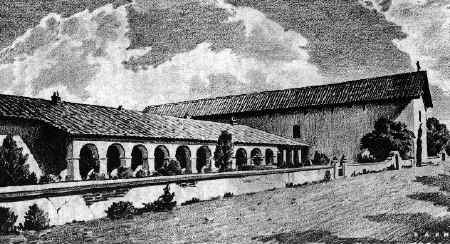 San Miguel de Arcángel (1797) Founded July 25, 1797, by Fr. Lasuén, the sixteenth mission, beside a Salinan village called Vahca near the Salinas River. It is named for the Archangel Michael. Fr. Buenaventura Sitjar, who spoke the Salinan language, directed the first building. The present church went up in 1816-1818 from adobe bricks stockpiled after a fire, and its interior was painted about 1820 by Estévan Munras; its colors survive as the best-preserved mission church interior in California. Secularized in 1836, the mission lost its last Franciscan in 1841; the property was sold in 1845, returned to the Church in 1859, and rented out until a priest took up residence again in 1878. The Franciscans returned in 1928 and have kept the mission since as a parish and monastery. |
 San José (1797) Founded June 11, 1797, by Fr. Lasuén, the fourteenth mission, on the east side of San Francisco Bay. It is named for St. Joseph. The mission drew its people from the Ohlone of the East Bay and, as recruitment spread inland, from Miwok and Yokuts peoples. Fr. Narciso Durán, who arrived in 1806 and stayed twenty-seven years, made the mission known for its music: he taught the mission Indians to make and play instruments, and its orchestra and choir were in demand across Alta California. The adobe church was dedicated in 1809. Secularized in 1836 and sold in 1846, the mission served gold rush miners as a trading post; it was returned to the Church in 1858. The earthquake of 1868 destroyed the church, and a wooden Gothic church took its place. In 1985 a replica of the mission church, rebuilt with mission-era materials and tools, was completed on the site; part of the padres' wing survives as a museum. |
 San Fernando Rey de Espana (1797) Founded September 8, 1797, by Fr. Lasuén, the seventeenth mission, on the ranch of Francisco Reyes in the valley north of Los Angeles. It is named for St. Ferdinand III, king of Castile. The mission served the Tataviam, called Fernandeño, and neighboring Tongva people. The church was finished in 1806, and the colonnaded Long Building rose between 1810 and 1822. In 1842 gold was found on the mission's lands, six years before the discovery at Coloma. Secularized in 1834, the mission served as military headquarters for Governor Pico and Colonel Frémont; its lands were sold in 1846, and seventy-five acres were returned to the Church in 1861. Charles Lummis and his Landmarks Club began restoration in 1896, and the Oblate fathers took up the mission in 1923. The 1971 earthquake destroyed the church, replaced by a replica in 1974; the Long Building, the largest adobe structure surviving from mission days, was repaired after the earthquake of 1994. |
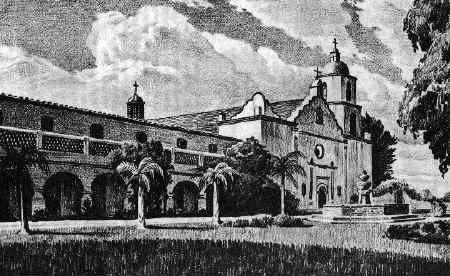 San Luis Rey de Francia (1798) Founded June 13, 1798, by Fr. Lasuén, the eighteenth mission. It is named for St. Louis IX, king of France. Fr. Antonio Peyri, who governed the mission for thirty-four years, built it into the largest of the chain, called the King of the Missions. The people of the surrounding country were the Luiseño. The present church, begun in 1811, was dedicated in 1815. Secularized in 1834 and sold, then occupied by Frémont's troops in 1846, the mission was partly returned to the Church in 1865. Franciscans began restoring it in 1893 as a seminary. The Franciscans own it today; it serves as a parish church and retreat house, and a pepper tree planted in the courtyard in 1830 is accounted the first of its kind in California. |
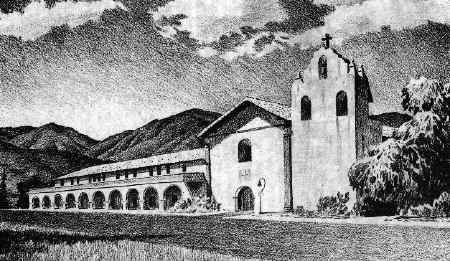 Santa Inés (1804) Founded September 17, 1804, by Fr. Estévan Tápis, the nineteenth mission, near the Santa Ynez River, to relieve the crowding of the Chumash missions at Santa Barbara and La Purísima. It is named for St. Agnes. The people of the area were the Ineseño Chumash. After the earthquake of 1812 destroyed the first church, the present church was built and dedicated on July 4, 1817. In the Chumash revolt of 1824, fighting between the mission Indians and soldiers set fires that burned part of the church; the interior was repainted the next year in the designs still visible. Secularized in 1836, the mission shared its grounds with California's first college, the College of Our Lady of Refuge, established in 1843 under Bishop García Diego; the college moved away in 1846 and the mission lands were sold. Part of the property was returned to the Church in 1862. Never wholly abandoned, the mission was restored through the twentieth century and is today an active parish served by the Capuchin Franciscans. |
 San Rafael de Arcángel (1817) Founded December 14, 1817, by Fr. Vicente Sarría, the twentieth mission, on the north shore of San Francisco Bay. It began as a hospital branch of Mission Dolores, to which sick neophytes were sent for the milder climate, and it took its name from the Archangel Raphael, the patron of healing; it also answered the Russian presence at Fort Ross. It became a full mission in 1822, and by 1828 more than a thousand people, most of them Coast Miwok, were living there. Secularized in 1834 under General Vallejo, who carried off its livestock, equipment, and even its fruit trees to his Sonoma ranchos, the mission was abandoned by 1842. Six and a half acres were returned to the Church in 1855, but the buildings were demolished. Nothing original survives; the present chapel is a 1949 reconstruction near the site. |
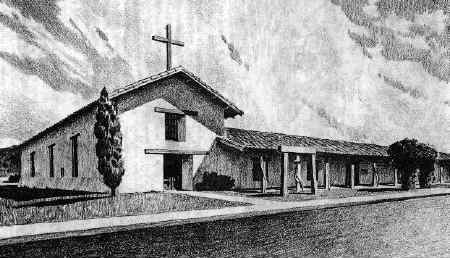 San Francisco de Solano (1823) Founded July 4, 1823, by Fr. José Altimira, the twenty-first and last mission, and the only one founded under Mexican rule. Fr. Altimira began it without his superiors' approval, hoping to replace Missions Dolores and San Rafael; the governor let him proceed, partly as a check on the Russians at Fort Ross. It is named for St. Francis Solano, a Franciscan missionary to Peru. The northernmost mission, it served Coast Miwok, Wappo, Pomo, Patwin, and Suisun peoples. After fire destroyed the first church in 1826, Fr. Fortuni rebuilt in adobe. Secularized in 1834 with General Vallejo as commissioner, the mission lost its lands to his ranchos; Vallejo laid out the town of Sonoma in 1835 and built a parish chapel on the old site in 1840. In June 1846 American settlers seized Sonoma in the Bear Flag revolt. The state acquired the mission in the early 1900s and restored it; it is now part of Sonoma State Historic Park, and the padres' wing, the only original section, holds a museum of mission paintings. |